
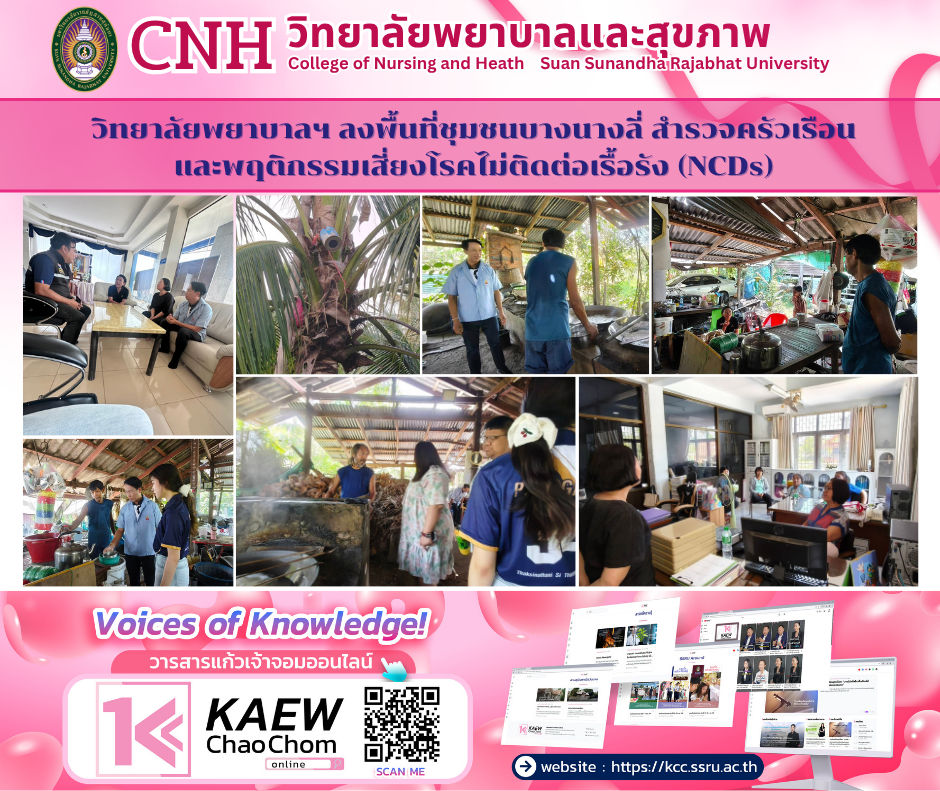
Community Field Visit in
Bang Nang Li: Household Survey and
Assessment of
Risk Behaviors for
Non-Communicable Diseases
(NCDs)
---------------------------------
15–17
December 2025 The College of Nursing and
Health, Suan Sunandha Rajabhat
University, in collaboration with Bang
Nang Li Subdistrict Administrative
Organization and Bang Nang Li Health
Promoting Hospital,
conducted a
field visit in Bang Nang Li Subdistrict,
Amphawa District, Samut Songkhram
Province. The purpose was to survey
households and organize
household/community group meetings,
focusing on collecting baseline health
data and identifying risk behaviors
associated with non-communicable
diseases (NCDs), such as diabetes,
hypertension, and
hyperlipidemia.
This initiative
aimed to establish a community-level
health database that reflects the
overall health situation and behaviors
of the population. The data will support
the design of health promotion and
disease prevention strategies that are
aligned with the actual context and
needs of the community.
The
activities included in-depth household
surveys, interviews with local
residents, and small group discussions
to encourage community participation.
These provided opportunities for
residents to express concerns, share
experiences, and collaboratively analyze
health risk factors at both household
and community levels.
The
implementation showed strong cooperation
from the community, including community
leaders, village health volunteers, and
local residents. This reflects the
strength of the community health network
and the awareness of individuals in
taking care of their own and their
families’ health.
The data
collected from this fieldwork will be
used to develop health promotion models
and support behavior change strategies
aimed at reducing the long-term risk of
NCDs. Ultimately, this will contribute
to improving the quality of life of
people in the community in a sustainable
way.
This initiative is aligned
with the Sustainable Development Goals
(SDGs), particularly Goal 3: Good Health
and Well-being, which focuses on
reducing risks and preventing
non-communicable diseases at the
population level, and Goal 17:
Partnerships for the Goals, through
collaboration among educational
institutions, government agencies, and
the community.