
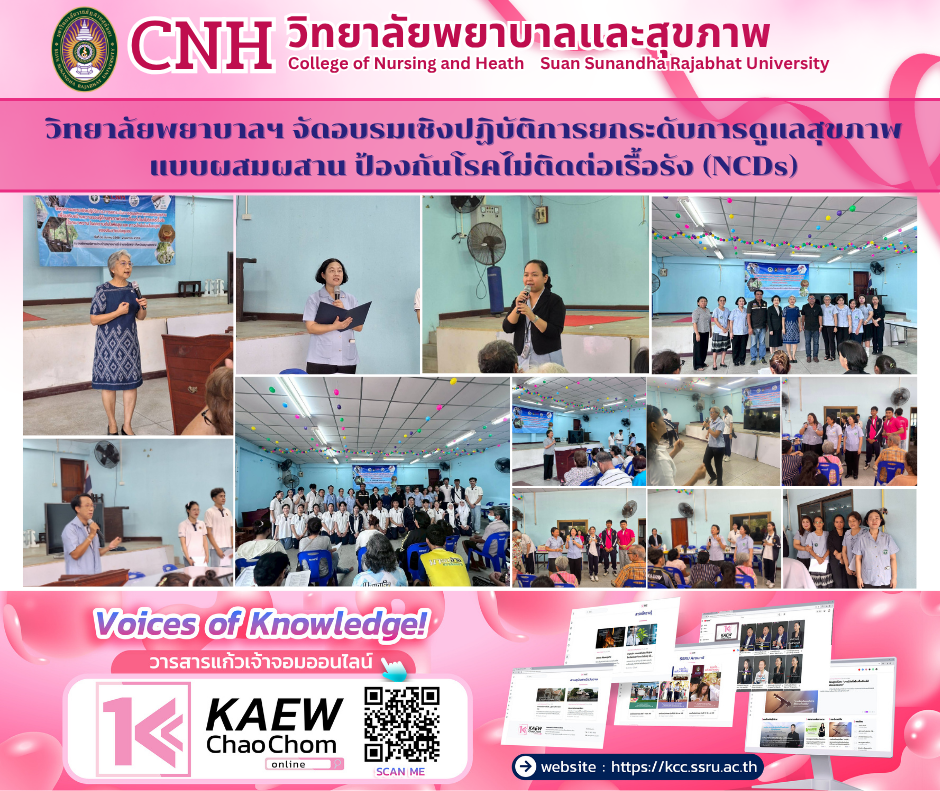
Workshop on Enhancing
Integrated Health Care for the
Prevention of Non -Communicable Diseases
(NCDs)
---------------------------------------
30–31
March and 1–2 April 2026 The
College of Nursing and Health, Suan
Sunandha Rajabhat University, in
collaboration with Bang Nang Li
Subdistrict Administrative Organization
and Bang Nang Li Health Promoting
Hospital,
organized a workshop
entitled: “Enhancing Integrated
Health Care to Strengthen Health
Literacy for the Prevention of
Non-Communicable Diseases (NCDs)”
held at Bang Nang Li Subdistrict
Administrative Organization, Amphawa
District, Samut Songkhram
Province.
The objective of this
project was to enhance health literacy
and develop the capacity of community
members to modify their health behaviors
in order to reduce the risk of
non-communicable diseases, such as
diabetes, hypertension, and
hyperlipidemia.
The training
activities included lectures on the
current situation of NCDs, development
of holistic health care skills covering
both physical and mental aspects, basic
health screening, and hands-on practice
in using technology for health promotion
through the LINE Official Account
application.
In addition, the
program promoted learning from local
wisdom by showcasing community-based
health products, such as dried pomelo
peel tea and low glycemic index (Low GI)
coconut sugar, as alternative options
for health care that are suitable for
the community context.
The
results showed that participants gained
increased knowledge and understanding of
health care, developed skills in
assessing and modifying their own health
behaviors, and demonstrated greater
awareness of NCD prevention. This
reflects tangible improvements in health
capacity at the community
level.
This project aligns with
the Sustainable Development Goals
(SDGs), particularly Goal 3: Good Health
and Well-being, which focuses on
reducing the risk of non-communicable
diseases through health literacy, and
Goal 17: Partnerships for the Goals,
through collaboration among educational
institutions, local authorities, and
health service providers.
This
workshop therefore serves as an
important mechanism for translating
knowledge into practice and
strengthening the community health
system, ultimately leading to
sustainable improvements in the
well-being of the population in the long
term.