
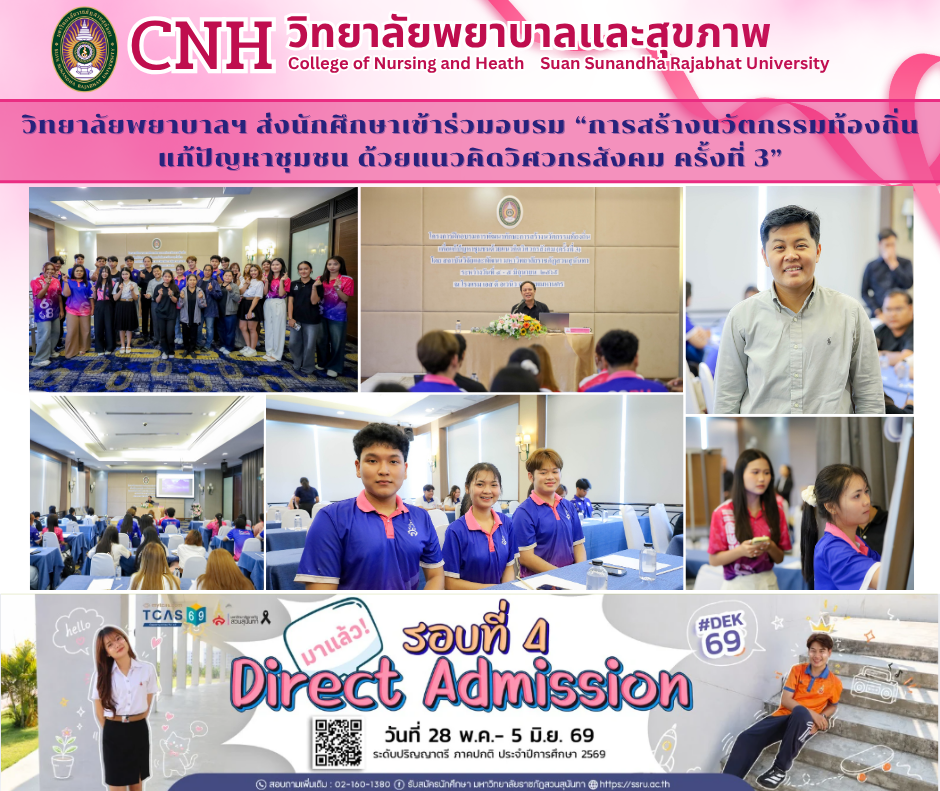
The College of Nursing
and Health sent students to participate
in the training “Creating Local
Innovations to Solve Community Problems
Using the Social Engineering Concept
(3rd
Session)”.
From
June 4-5, 2026, the College of Nursing
and Health sent student representatives
to participate in the training program
“Developing Skills in Creating
Local Innovations to Solve Community
Problems Using the Social Engineering
Concept (3rd Session)” under the
project to develop entrepreneurial
competencies for local development
through Soft Skills processes (Social
Engineering) for the fiscal year
2026.
The opening ceremony was
presided over by Assistant Professor
Atittiya Buasri, Deputy Director for
Intellectual Property Management and
Business Incubation. The training aimed
to enhance knowledge, understanding, and
skills in applying the “social
engineering” concept in creating
local innovations to solve community
problems effectively and sustainably,
while integrating Soft Skills with the
local context so that students can
develop approaches that truly meet the
needs of the community.
The event was
honored by the presence of Assistant
Professor Panuwat Sivaskulraj, Deputy
Dean for Student Affairs, Faculty of
Education, Suan Sunandha Rajabhat
University, and Assistant Professor
Atittiya Buasri, Deputy Director for
Intellectual Property Management and
Business Incubation. The Research and
Development Institute, Ms. Buppha
Waijaroen, President of the Suan Nok
Agricultural Community Enterprise in
Bang Khon Thi District, Samut Songkhram
Province, Ms. Pannipa Kongnuch, Ms.
Wilailak Chaemklam, and Mr. Boonkong
Chaemklam from the Ban Kwae Om
Sufficiency Agriculture Community
Enterprise in Amphawa District, Samut
Songkhram Province, served as speakers,
sharing their knowledge, experience, and
approaches to working with communities
with students at the Chomnapha Meeting
Room, S.D. Avenue Hotel,
Bangkok.
This project aligns with
several dimensions of the Sustainable
Development Goals (SDGs), including SDG
4, Quality Education, by promoting
lifelong learning, developing soft
skills, and creative thinking processes
through the social engineering concept,
enabling students to apply their
knowledge to community development in a
tangible way. It also aligns with SDG 8,
Decent Work and Economic Growth, by
developing students' potential in
innovation skills, analytical thinking,
and community collaboration, which are
fundamental to creating sustainable
livelihoods and grassroots
economies.
Furthermore, it connects
with SDG 9, Industry, Innovation and
Infrastructure, by supporting the
creation of local innovations from
research and community participation to
solve local problems using innovative
thinking processes, as well as SDG 11,
Sustainable Cities and Communities. This
initiative aims to promote community
development through the integration of
university knowledge with local wisdom
and the 17 Sustainable Development Goals
(SDGs), reflecting collaboration between
the university, experts, and community
networks in developing student
capabilities and driving sustainable
local development.